Recently, I ventured back to Five Winds School of T’ai Chi Chuan. I was last there in February 2020 – and we all know what happened next.
With physical contact off-limits, I kept up my T’ai Chi Chuan practice by doing the beautiful solo forms of this martial art. Then, in August 2022, with physical contact resumed, I took part in a Leadership Embodiment (LE) retreat, having supported the founder of LE, Wendy Palmer, to put it in place. The retreat was amazing. Inspired by it – and by the fact that LE practices had been a key personal support during the pandemic – I resolved to put the LE pathway at the centre of my work. Whilst LE practices have always been an essential part of my coaching, supervision and dialogue work, I’d stopped offering the formal training programmes in 2016 (ish). Fired up, I made plans to offer ‘Level 1’ programmes to support Wendy’s bigger aspirations for the practices.
In choosing this focus, I decided not to return to T’ai Chi classes: I’d continue to practise solo forms locally, and do ‘partner work’ through my LE programmes and by joining Wendy’s retreats whenever possible.
I had a plan. And … as described in my previous post … things change.
By the time I was hosting LE Level 1 in November 2022, Wendy was in hospice care. She died in early December 2022, and I miss her still. However, through the efforts of the many accredited teachers and coaches, and under the guidance of Wendy’s daughter and business partner, Tiphani, LE work continued. For a while, I soldiered on.
Things changed again as I brought my client work to a close in order to complete Approaching Difference Differently. Then, as part of the process of reclaiming my sense of self after that endeavour, I resolved to return to Five Winds.
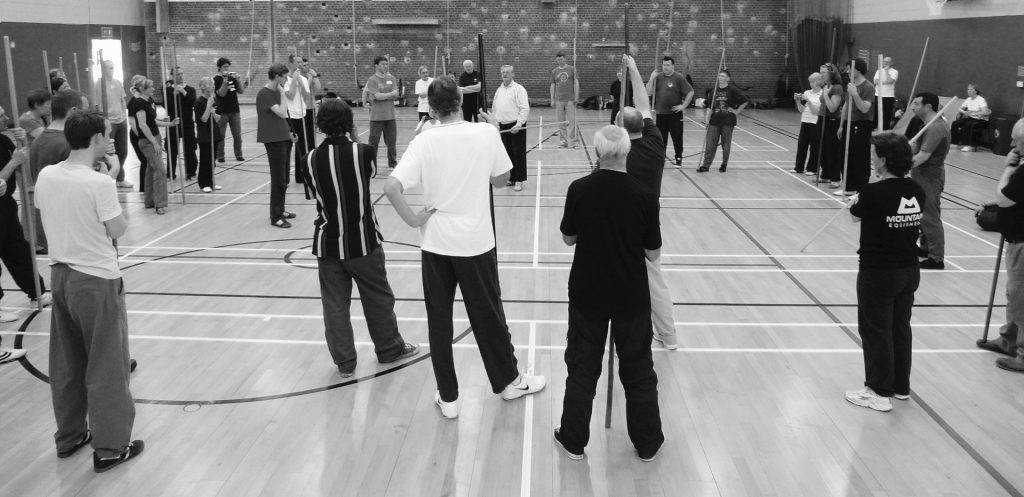
With some trepidation, I set off on the 2.5 hour drive one Saturday morning – but forgot to factor in a rugby international: I arrived, somewhat tense, an hour late. The room was filled with pairs of people – many of whom were familiar faces. They were practising a martial ‘application’ called ‘single sweep the lotus’ in response to a punch. I plunged straight in, joining a pair of former sparring partners. I was somewhat clunky, not least because I’d rarely practised this movement even when regularly attending class. However, I was there to learn – and got on with it.
When the activity changed, I sought out the teacher and explained my reappearance, apologising for my lateness. I asked if I could reacclimatise by doing some ‘pushing hands’ practices, which are, in effect, partner forms: they have a pattern and are a little more predictable than martial applications. This would give me a measure of my rusty partner practice.
My partner – another familiar face (and body) – set us in motion. After a few seconds of ‘oh-my-goodness’ confusion, my body memory kicked in. It was a wonderful experience, a sense of ‘oh! hello!’. I stuttered a little when my partner changed the direction of our practice, and again when she initiated a more complex version of it. However, if I could ‘suspend’ my thinking mind and simply witness my experience, my body knew what to do. Reader, it was SO lovely to be back.
This brings us to body memory, the heart of this piece. My experience was that of the old adage about ‘riding a bike’. After 6 years of absence, 25 years of previous practice won the day. The ability of the body to call on an embodied memory established through repetition and practice is a beautiful thing. It’s a quality that we can put to good use and it underpins the LE practices that have been the backbone of my personal development and work for 16 years.
In LE, as in martial arts, we learn to notice unhelpful body memories and to cultivate alternative, skilful ‘memories’ by building new neural pathways through repetition. The foundation of LE* is a single ‘centring’ practice, through which we access a powerful, inclusive presence that changes how we relate to adverse events. If we practise it, we interact with the world with more ease and poise.
Contemplations
- How does your body react in moments of stress – whether prompted by a deadline, a criticism, volume of work or a person you find challenging to be around? How does this affect what you say and do?
- In contrast, what happens in your body when you are ‘on form’ or ‘in flow’ – when you speak and act with ease and confidence? This is a glimpse of a centred state – what might change if you were able to access this state more often*?
~II~
* You can find accredited teachers and coaches at https://leadershipembodiment.com/global-team/ and you can find a detailed exploration of the LE centring practice in Approaching Difference Differently

