In July, I described my evolving sense of ‘success’ for pieces of writing, sharing that, for me, meaningful measures are:
- thoughtful reflections in response to my posts; and
- well-used, tatty copies of my books.
I also confessed to my resistance towards anything that feels like ‘marketing’ and ‘selling’, and resolved to do something about this. I finished the piece with ‘… to be continued!’
And so, to continue!
In the intervening weeks, I’ve read posts, had conversations and even consulted ChatGPT about marketing. In each case, I’ve taken conventional wisdoms and reworked them for my context. Along the way, I’ve realised that I’m willing to encourage ‘meaningful purchase’ of my books, by which I mean a purchase that leads to the material being used.
With this perspective, two things have emerged. First, I’m wondering what prompts us to buy a particular book and what then inspires us to adopt what we read? Second, and more important, I now understand that what really matters to me is not the books themselves, but what’s made possible through the disciplines of dialogue, embodied practice and reflecting on the way we show up in leadership and life.
The bottom line? My heartfelt wish is that my books support people to engage in important conversations in a meaningful way. What lies behind this?
I’ve often written that conversation is the medium through which most leadership is conducted and expressed. More recently, I’ve been saying that it’s the medium through which most of life is conducted and expressed. In each moment, we’re in conversation with ourselves, with each other and with the world – what might change if we attended more closely to the way we participate in these exchanges?
For example, a participant in one of my dialogue programmes described her young daughter coming home from school and saying, ‘Mummy, I hate you’. You can imagine how she felt: hurt, confused, angry. However, she recalled what we’d explored in the previous workshop and quickly recovered her presence and perspective. Then, with genuine curiosity, she asked: ‘can you tell me a little bit about what you mean?’
It turned out that her daughter didn’t know what ‘hate’ meant – she was simply repeating a phrase she’d heard in the playground. When her mum gently explained the meaning, she said ‘Mummy, I don’t hate you … I love you.’
In being curious about what shaped her daughter’s words and being equipped to hold herself in presence, despite the impact of them, this young woman changed the course of the conversation.
Which leads me to wonder what might change if more of us were genuinely curious about how others come to see things as they do, and were able to engage skilfully with the opposition and/or challenge that naturally arises? What if more of us were able to be in dialogue, shifting our focus from what we’re saying (or planning to say) to how we engage with others and create conditions for both good outcomes and healthy rapport.
The world needs dialogue (to borrow a phrase from the Academy of Professional Dialogue). This is especially true of leadership in a complex adaptive world. Dialogue is the form of conversation best suited to the dynamic, interdependent and multi-faceted challenges of these times: it can support us to navigate nuance, ambiguity, uncertainty and passionately held views. Thankfully, with application, we can build capacity for dialogue.
And so, my real heartfelt wish is that more people become familiar with the practices of dialogue and able to embody them. I want to encourage both this and those involved in dialogue work, although it’s impossible to measure the impact of such activities. And yet, they’re meaningful anyway – perhaps I’m becoming a ‘dialogue warrior’, which suits my martial spirit!
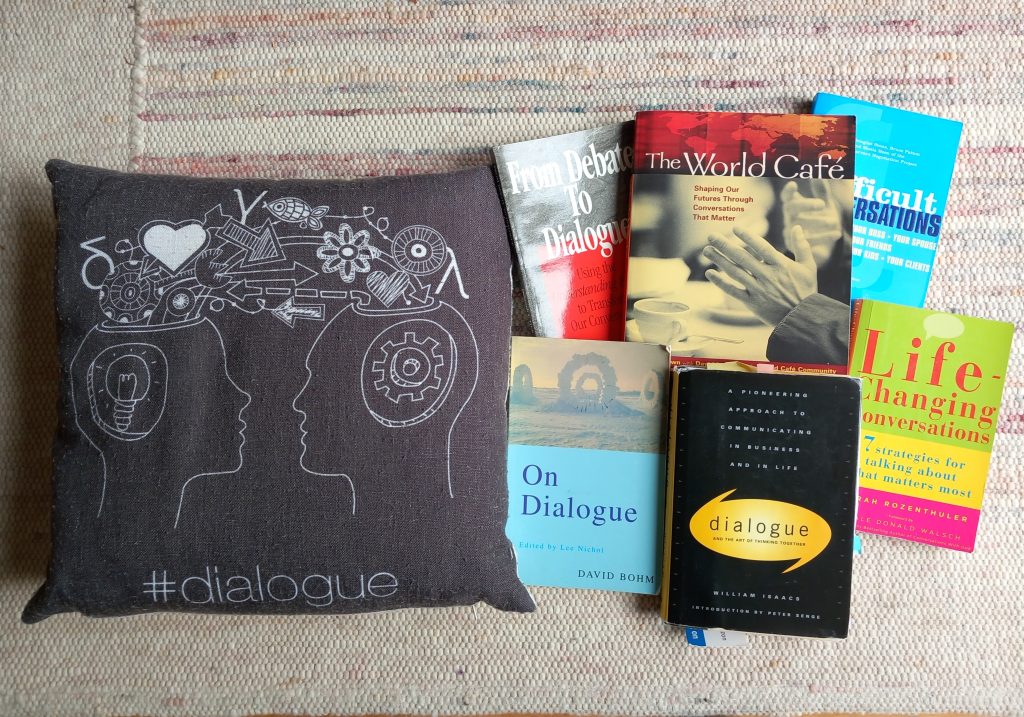
Which brings me to the cushion in the accompanying photo: my friend and supporter Lorna Jackson gave it to me years ago. When I work, it’s at my back which, in the embodied practices that I champion, is where we call up sources of support and inspiration from which we can draw the courage, confidence and energy to act.
In all I do, dialogue is at my back.
Contemplations
- Who and/or what supports You? Who and/or what inspires you?
- If you imagine these sources of support and inspiration behind you, cheering you on, what changes?

